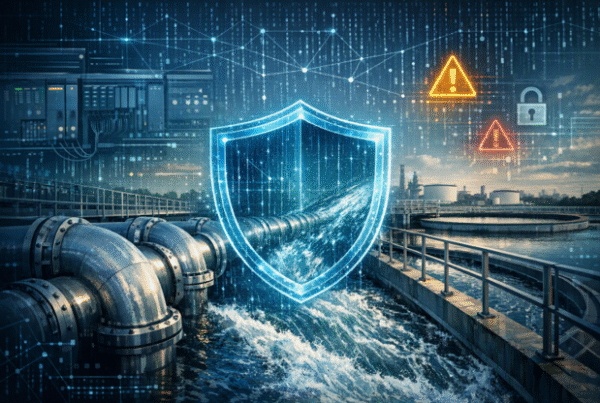

Municipal Utility Authorities (MUAs) deliver essential services that communities depend on every day—clean drinking water, wastewater treatment, stormwater management, and in some cases local power generation. MUAs have been investing heavily in modernizing Industrial Control Systems (ICS), Information Technology (IT) and Operational Technology (OT) that were not originally designed to withstand today’s cyber threats or evolving physical risks.
As cyber incidents, natural disasters, network outages, and infrastructure failures rise in frequency and impact, MUAs modernizing efforts face critical operational challenges that are compromising safety, reliability, and affordability. The most effective path forward is not through complexity, but through achieving foundational resiliency, building local accountability, and consulting trusted advisories.
Achieve Foundational Resiliency in Municipal Utilities
Many high‑profile incidents impacting utilities have one thing in common—they stem from gaps in basic controls rather than sophisticated attacks. Foundational controls provide baseline protection that prevents minor issues from becoming major service disruptions, and appropriate response that enables timely recovery from incidents.
For municipal utilities, foundational controls include:
- Comprehensive asset visibility across pumps, treatment processes, SCADA systems, PLCs, sensors, and networks
- Logical and physical network segmentation between IT, OT, and external connections
- Incident response management that’s tailored for the ICS category
- Secure access management, especially for operators and vendors
- Configuration baselines and change discipline that reflect operational reality
- Offline backups and recovery procedures for control logic and critical systems
These practices reduce attack surfaces, limit the spread of incidents, and enable faster, safer recovery. More importantly, they protect public health outcomes—maintaining water quality, pressure, treatment integrity, and regulatory compliance during disruptions.
Foundational controls are especially critical for MUAs, which often operate under budget constraints and must justify every investment with operational value.
Building Local Accountability in MUA Environments
Municipal utilities are inherently local. Each facility serves a specific community, operates under local conditions, and faces distinct risks such as flooding, aging infrastructure, workforce limitations, or regional supply dependencies.
Local accountability captures the approach of having assigned support resource(s) who can perform basic troubleshooting and coordinate response to critical incidents within the required SLA (usually within 2 hours). Supporting MUA operations are control room(s) that comprise of the technology components, and they usually adopt a hub-and-spoke model for connectivity to various satellite locations.
This resource(s) usually works near a control room and ensures that resilience and cybersecurity are:
- Embedded into daily operations
- Immediately accessible to those closest to the systems and processes
- Aligned with on‑the‑ground realities
When plant managers, operations supervisors, and local IT/OT leads are accessible to this resource(s), the benefits are tangible:
- Incidents are recognized and reported earlier
- Response actions reflect actual operational priorities
- Recovery efforts focus on protecting water quality and service continuity
- Cybersecurity becomes part of safety and reliability culture, not just compliance
Local accountability does not replace centralized governance or regulatory oversight. Instead, it ensures that standards and policies are effectively implemented where service delivery happens.
Consult Trusted Advisory
Many MUAs operate with lean teams that excel in engineering and compliance but lack specialized cybersecurity or resilience expertise. At the same time, regulatory scrutiny, insurance requirements, and public expectations continue to grow.
This is where trusted advisory relationships provide exceptional value.
A trusted advisor in the municipal utility context:
- Understands water, wastewater, and utility operations
- Participates in consortiums such as WaterISAC and MS-ISAC
- Prioritizes safety, regulatory compliance, and public trust
- Offers independent, experience‑based guidance—not product‑driven recommendations
- Helps utilities make informed trade‑offs between risk, cost, and reliability
Trusted advisors help MUAs:
- Identify and prioritize high‑impact risks
- Establish practical, affordable foundational controls
- Align cybersecurity investments with operational realities
- Prepare for audits, assessments, and regulatory reviews
- Build defensible, sustainable resilience strategies
Most importantly, trusted advisors act as translators—bridging the language of cybersecurity, operations, engineering, and executive leadership.
Integrating for Sustainable MUA Resiliency
Inadequate response to incidents or mandates continues to strain MUAs and has become the root cause of catastrophic failures and loss in public trust. Foundational controls, local accountability, and trusted advisory are most powerful when implemented together:
- Foundational controls provide technical and procedural stability
- Local accountability ensures those controls are owned, maintained, and tested
- Trusted advisory ensures decisions are informed, prioritized, and defensible
For municipal utilities, resilience is about more than infrastructure—it is about safeguarding public health, environmental stewardship, and community trust. Efforts to integrate these actionable objectives can proactively strengthen resilience and cybersecurity while maintaining affordability and public confidence.