HomeProductsCulper-I

Culper-I: an Early Warning System (EWS) for water and wastewater systems

Built for cybersecurity and resiliency, Culper-I watches your SCADA, PLCs and remote sites around the clock, learns what normal looks like, and warns your operators the moment something changes, whether it is an intrusion or a failing connection, before it becomes an outage or malicious access affects water pressure and quality.

Culper-I datasheetPDF, 2 pages

Culper-I watches a control network and raises an early warning when a workstation sends an unexpected write command to PLC-2.

How early warning works.

Culper-I is passive. It listens to a copy of control network traffic and never sends commands to your equipment.

  1. Listen

    A Culper-I appliance in your control room sees every conversation between HMIs, PLCs, historians and remote sites.

  2. Learn

    Culper-I builds a baseline of normal: which devices talk, which commands they send, and when.

  3. Warn

    A new device, an unexpected spike, an off-hours login, an unstable network or a lost connection raises an alert to our operations center within seconds.

  4. Respond

    An analyst confirms it, calls your operator, and helps your team isolate the problem and run safely in manual.

The Culper-I EWS, on screen.

Culper-I is DT6’s Early Warning System (EWS). Every alert, device and finding lands in one console. Our analysts work in it around the clock, and your team gets its own login. Six, its AI, reads across all of it and says where to look first.

Control network

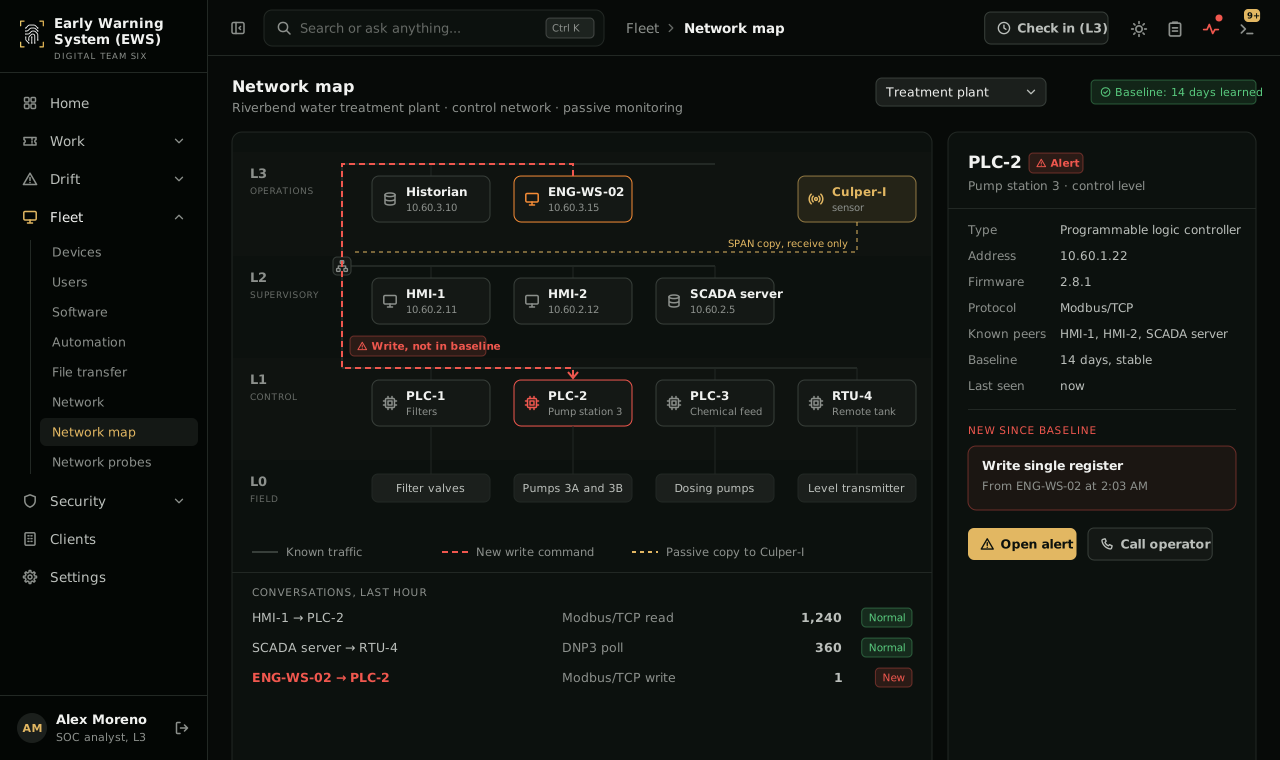
The Culper-I network map of a water treatment plant's control network, from the historian and engineering workstation down through the HMIs and SCADA server to four PLCs and their field equipment. A Culper-I sensor receives a passive copy of the traffic. A red dashed path marks a write command from engineering workstation ENG-WS-02 to PLC-2 at pump station 3 that is not in the 14-day baseline.
The control network, mapped. Culper-I learns which devices talk and which commands they send, level by level, from a receive-only copy of the traffic. Anything new stands out.
Open full size: Control network

An alert

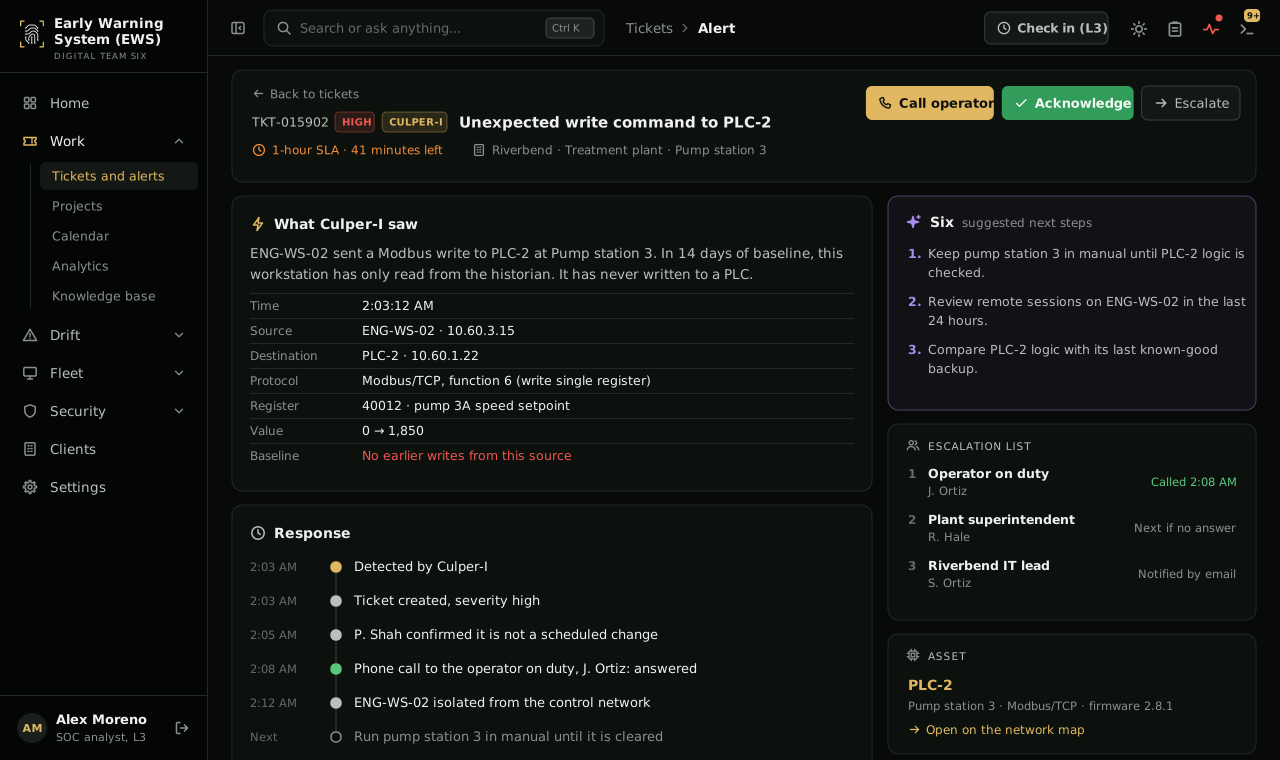
A high-severity Culper-I alert: an unexpected Modbus write from ENG-WS-02 to PLC-2 changed pump 3A's speed setpoint. The response timeline shows detection at 2:03 AM, an analyst's confirmation, a phone call to the operator on duty at 2:08 and the workstation isolated at 2:12, with 41 minutes left on the 1-hour SLA. Six suggests next steps, and the escalation list is shown.
An alert, end to end. What Culper-I saw, the evidence, the call to your operator and every step since, with the 1-hour clock running on a high-severity alert.
Open full size: An alert

AI recommendations

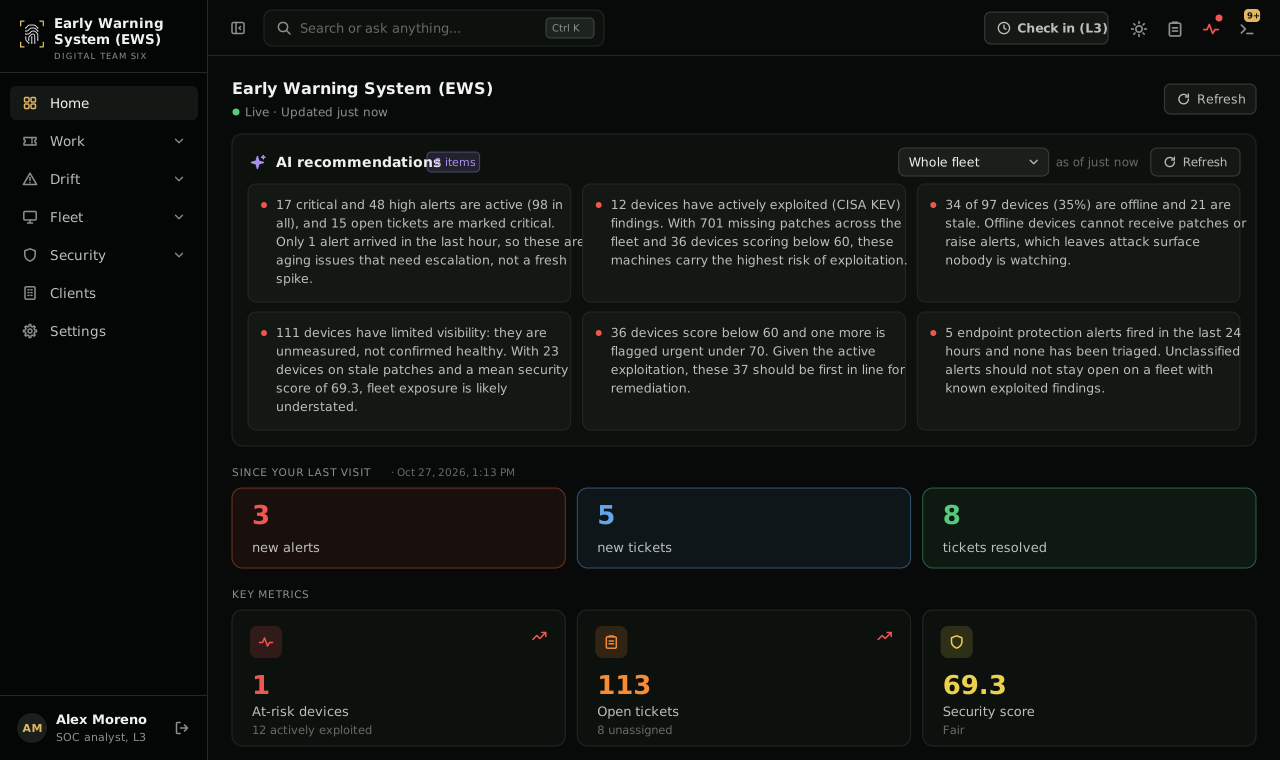
The Culper-I home screen. Six's AI recommendations sit at the top: 17 critical and 48 high alerts are active, 12 devices have actively exploited findings, and 34 of 97 devices are offline. Below are the changes since the last visit (3 new alerts, 5 new tickets, 8 resolved) and the key metrics: 1 at-risk device, 113 open tickets and a security score of 69.3.
The morning briefing. Six reads every alert, ticket and device and writes up what needs attention: what is critical, what is aging and what is exposed.
Open full size: AI recommendations

Key metrics

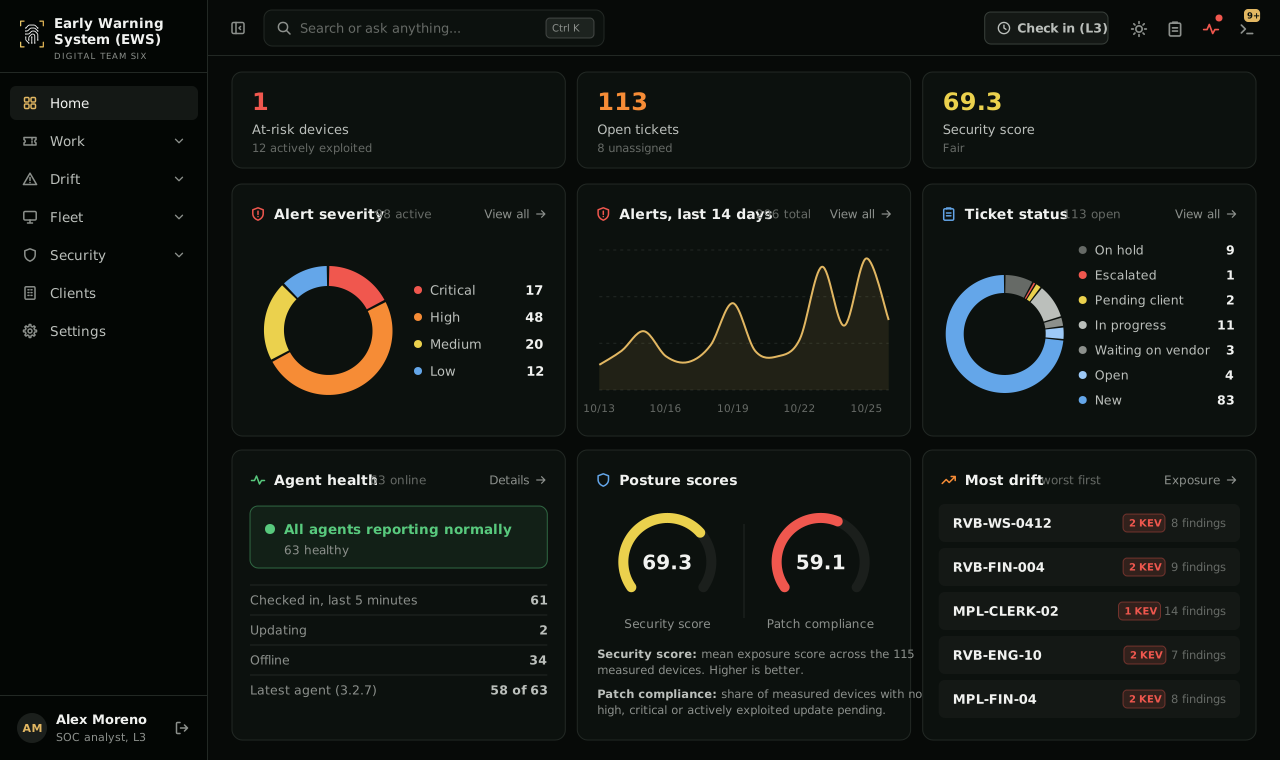
The Culper-I key metrics dashboard: 98 active alerts by severity (17 critical, 48 high, 20 medium, 12 low), a 14-day alert trend totaling 296, 113 open tickets by status, all 63 online agents reporting normally, a security score of 69.3 and patch compliance of 59.1, and the five devices with the most drift.
Key metrics. Alert severity, two weeks of alerts, ticket status, agent health, posture scores and the devices drifting furthest from their baseline, on one screen.
Open full size: Key metrics

Sample data. Clients, people, devices and addresses are illustrative.

One framework. Four disciplines.

Certified, compliant and managed. Culper-I is modular, so a small utility can start with a non-intrusive assessment and asset inventory, and add the rest as budgets allow.

01Asset management
An inventory of your IT and OT assets, with non-intrusive vulnerability assessments run when something changes, an audit is due or recertification comes around.
02Access management
Operator and administrator access managed locally in the control room, a secure kiosk mode for SCADA stations, and logged sessions for vendors and remote users.
03Network management
Segmentation built around your ICS, OT and SCADA assets and your legacy equipment, with secure remote access across control rooms.
04Incident management
An on-premises SIEM appliance for your control rooms, integrated with a dedicated, US-based SOC organized around your control system topology.

Three tiers. Start where you are.

Each tier includes everything in the tier before it.

Subscription planned for 2027

Monthly sector updates

Consolidated monthly updates on the themes that matter to water and wastewater systems.

  • Verified incident and threat intelligence affecting the sector
  • Vulnerability and technology updates for control room infrastructure
  • Funding and workforce opportunities in the sector
  • Up to five free subscriptions per agency

System

An EWS for MSP and MSSP partners

Everything in Subscription, plus:

  • A secure, real-time central view of cybersecurity and resiliency operations planned for 2027
  • Asset management, vulnerability assessments, risk management and reporting planned for 2027
  • Monitoring, alerting and reporting for Culper-I and its integrations, around the clock
  • Security controls and resiliency monitoring for cloud applications and on-premises assets

Solution

Managed resiliency, cybersecurity and governance

Everything in System, plus:

  • Managed secure remote access, site-to-site VPN and SASE
  • Governance and compliance management for MEL, OPRA, WQAA and EPA requirements
  • Incident response, root cause analysis and network management
  • Threat hunting, resiliency monitoring, response and advisory for water and wastewater
  • Non-intrusive network vulnerability assessment and reporting for control systems
  • Threshold-based monitoring and alerting, mapped to critical infrastructure requirements planned for 2027

Items marked 2027 are enhancements planned for 2027. A dedicated EWS is available for MSPs and MSSPs, and a dedicated solution environment for water and wastewater systems.

When Culper-I raises an alert.

Culper-I watches for failures as well as attacks. Every alert is graded by severity, and the grade sets how we notify you and the service level we work to.

SeverityResiliencyCybersecurity
HighPhone call and ticket1-hour SLA. Outages and loss of operator access.1-hour SLA. Signs of compromise in an asset, the network or user activity.
MediumTicket6-hour SLA, or residual risk accepted. Degraded performance and unstable connections.8-hour SLA, or residual risk accepted. Vulnerabilities with no evidence of compromise.
LowTicket1-week SLA, or residual risk accepted. Legacy operating infrastructure.8-hour SLA, or residual risk accepted. Minor version patches less than 60 days overdue, with no security vulnerabilities.

SLA: service level agreement.

Integrate, intel, customize.

How we run Culper-I day to day: integrate with what you have, turn data into intelligence, and customize controls to your plant.

Integrate

Objectives alignment

  • Scans on demand, on a schedule, or when a change or audit triggers one
  • Non-intrusive asset and vulnerability scanning built for legacy and sensitive equipment
  • Log collection, custom protocols and API integration with SCADA, DCS and PLC vendors
  • Aligned with your industry’s compliance and regulatory requirements

Intel

Ongoing managed tasks

  • A dedicated SOC built around your ICS topology
  • Event correlation and pattern-deviation detection
  • Investigation across users, devices, networks, hardware and software
  • Technical, personnel and management responses to every finding

Customize

Access control management

  • Network segregation and continuous monitoring
  • Restrictive user and logical access, including kiosk mode for operator stations
  • Policies for patching, credentials, MFA, allow-listing, firewall rules and backups
  • Alert thresholds tuned to your operations

What Culper-I watches.

Every system that treats, pumps or monitors water now connects to something. Culper-I covers the control systems, and our SOC and MSSP++ cover the office network they connect to.

  • Process control (ICS/SCADA)
  • Instrumentation and field devices
  • Chemical feed
  • Pumping and distribution
  • Safety instrumented systems
  • Telemetry and communications
  • Smart water and IoT
  • Power and electrical
  • Building management
  • HVAC and environmental

The result: water and wastewater compliance.

Culper-I keeps an inventory and a record of what it watched, so compliance becomes a by-product of protection.

RequirementWhat it asksWhat Culper-I provides
Safe Drinking Water Act, Section 1433Community water systems over 3,300 peopleAssess the security of electronic, computer and automated systems, plan your response, and recertify to EPA every five years.A current asset inventory, exposure findings and incident records that feed your Risk and Resilience Assessment and Emergency Response Plan.
NJ Water Quality Accountability ActNJ systems over 500 service connectionsA cybersecurity program aligned to NIST CSF, CIS Controls or ISO 27000, with incident reporting to NJCCIC.Monitoring and access controls mapped to the framework you choose, and incident details ready for NJCCIC.
New York State Department of Health, Appendix 5-ENY community water systems over 3,300 peopleA cybersecurity program, a yearly vulnerability analysis, and incident reports within 24 hours.An asset inventory, vulnerability findings and incident details ready for NYSDOH.
New York DEC wastewater rulesNY publicly owned treatment worksWritten access, asset, network and incident response controls, and incident reports within 24 hours.The four Culper-I disciplines map to those controls: asset, access, network and incident management.
NJ MEL Deductible Reduction GroupsMembers of a municipal Joint Insurance FundThree levels of controls. Members who meet them can reduce the deductible on a cyber claim by up to $80,000.Support for Basic, Intermediate and Advanced Security, with the evidence your JIF asks for. The groups, explained
NIST SP 800-82 and SP 800-53Federal guidance for operational technologySecurity controls from the federal catalog, tailored for control systems.Non-intrusive vulnerability assessments to SP 800-82, and annual risk assessments that follow the NIST Risk Management Framework.
CISA Cybersecurity Performance GoalsAll critical infrastructureA baseline of practices such as asset inventory, changing default passwords and logging.Inventory, default-credential findings and logs collected continuously.

From discovery to live monitoring.

Three phases for each control room, scheduled around your operators.

  1. 1 day on site, 2 days to report

    Discovery

    A non-intrusive vulnerability assessment to NIST SP 800-82 and asset discovery, with a report on your network topology, asset inventory, risks and remediation priorities.

  2. 2 weeks in our lab

    Staging

    We set up the components in the DT6 lab, map your network and trust zones, and configure and test the monitoring rules before anything reaches the plant.

  3. 2 days on site

    Deployment

    Setup in your control room during manned hours, then operational testing with your plant operators and SCADA integrator.

Timelines are per control room. Your operators, SCADA integrator and stakeholders need to be available on site, and the internet, cellular or fiber connection at each site is the utility’s to provide.

What happens in a demo.

One working session with an OT engineer, built around your plant rather than a slide deck.

  1. Your objectives

    Review your current resilience and security goals.

  2. The modules

    See Culper-I’s modules working on real control traffic.

  3. Your controls

    Map control objectives to your organization’s goals.

  4. The plan

    Walk through the framework and how implementation would run.

Questions operators ask.

No. Monitoring is passive. It listens to a copy of network traffic and never sends commands to control equipment. Vulnerability assessments are non-intrusive, follow NIST SP 800-82, and run only with your approval.

Your integrator keeps the process running. Culper-I keeps it secure and resilient, giving your integrator better options and secure connectivity without compromising operator efficiency.

Start with an on-demand assessment to measure your operations against EPA compliance requirements. Many small systems add access management next and monitoring later, as budgets allow.

For each control room: a day on site for discovery and two days to write the report, about two weeks of staging in our lab, then two days on site to deploy, during manned hours.

Our operations center confirms it. A high-severity alert, such as an outage, lost operator access or signs of compromise, reaches the operator on duty by phone and ticket within the hour, using the escalation list agreed with you. Then we help your team isolate the problem and run safely in manual.

See Culper-I on a control network like yours.

One working session with an OT engineer, built around your plant rather than a slide deck.

Prefer to talk now? 973-339-0090