
QVULT: public key infrastructure (PKI) as a service

QVULT finds every certificate you own, renews it before it expires, and runs your private PKI for you, whichever certificate authority issued it, so an expiry never takes a portal, VPN or control system connection down.

QVULT datasheetPDF, 2 pages

QVULT counts down expiring certificates and renews each one automatically, leaving 412 certificates healthy.

Certificate lifetimes are shrinking. Fast.

Every public TLS certificate issued since March 15, 2026 expires within 200 days, and the limit keeps falling. Renewing by calendar reminder will not survive the schedule.

  1. Mar 15, 2026
    In effect now

    200 days maximum validity for public TLS certificates.

  2. Mar 15, 2027

    100 days maximum validity. Most certificates renew three or four times a year.

  3. Mar 15, 2029

    47 days maximum validity, with domain validation reuse cut to 10 days. Manual renewal stops being realistic.

    Source: SSL Insights, CA/Browser Forum 47-day roadmap

What QVULT does.

A managed service, not another tool for your team to learn. Our experts install, update and watch it with you.

01Discovery and inventory
Find certificates across on-premises, cloud and hosted systems, legacy and modern, whatever their lifecycle stage.
02Lifecycle automation
Auto-enrollment for each asset type, with renewal and revocation handled before deadlines arrive.
03Private PKI as a service
A managed private PKI using NIST-approved algorithms, aligned with zero trust.
04Any certificate authority
Works across multiple public and private CAs, so you keep the providers you already use.
05Critical systems first
On-demand prioritization puts the certificates that keep services running at the front of the queue.
06Monitoring around the clock
Continuous monitoring with a low-impact, minimal-footprint deployment.

Every certificate, in one view.

QVULT tracks each certificate’s authority, owner and expiry, renews it before the deadline, and shows you the few that still need a person.

Inventory

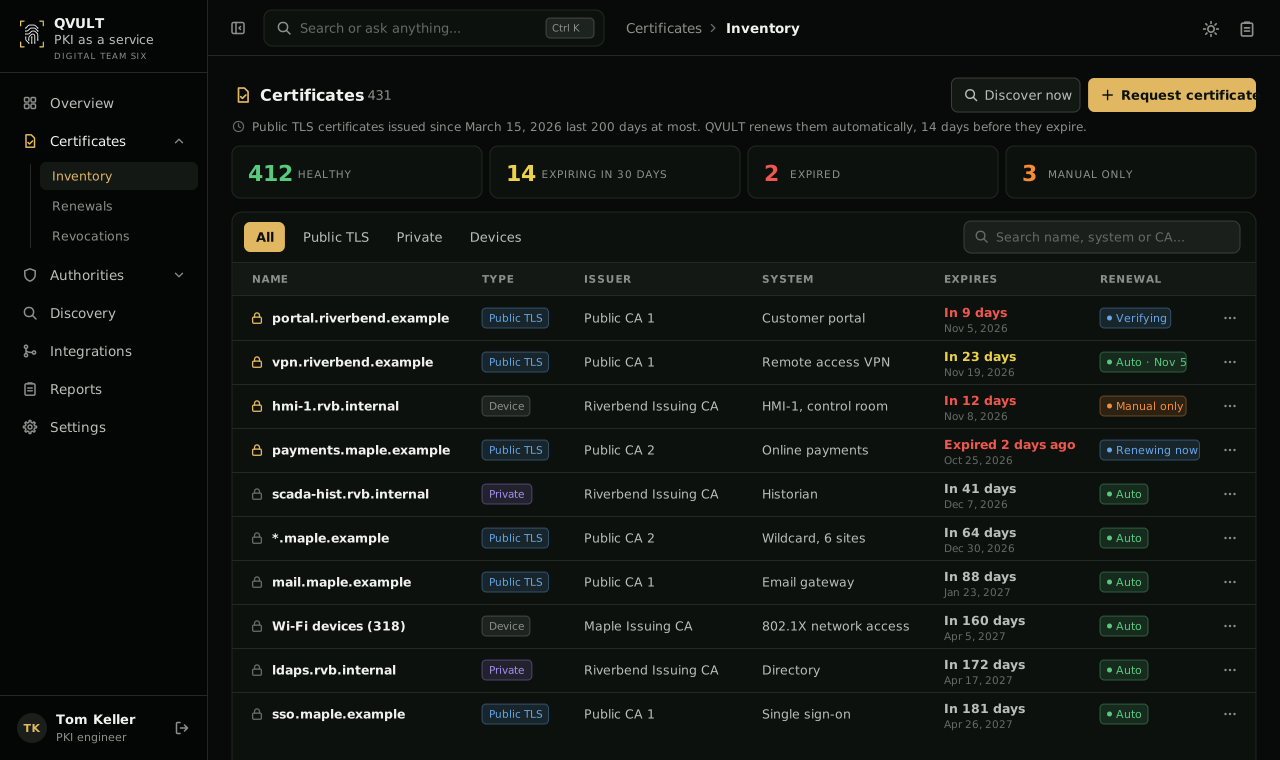
The QVULT certificate inventory: 431 certificates, with 412 healthy, 14 expiring within 30 days, 2 expired and 3 that can only be renewed by hand. The table lists each certificate with its type, issuing authority, the system it protects, the days until it expires and how it renews, such as a customer portal certificate being verified after renewal and an expired payments certificate being renewed now.
Certificate inventory. Public, private and device certificates from every authority in one list, with what each one protects and how it renews.
Open full size: Inventory

Renewals

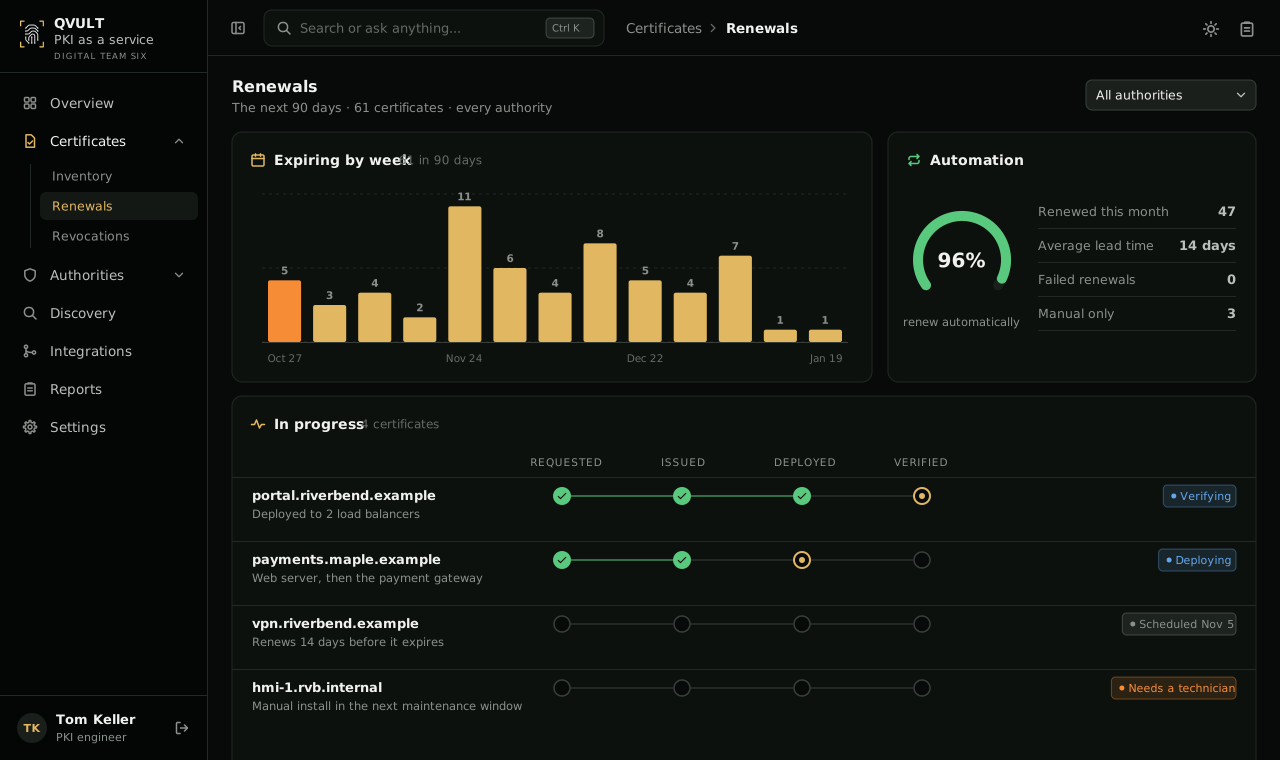
The QVULT renewals screen: 61 certificates expire in the next 90 days, shown as a weekly bar chart. 96 percent renew automatically, 47 were renewed this month and none failed. Four renewals in progress show their stage from requested to verified, including one that needs a technician in the next maintenance window.
Renewals. What expires each week for the next 90 days, how much renews on its own, and how far each renewal in progress has got: requested, issued, deployed or verified.
Open full size: Renewals

Illustrative screens with sample data.

From spreadsheet to automatic.

A turnkey, accelerated deployment that starts with what you already have.

  1. Discover

    Inventory every certificate, owner and expiry date across your environment.

  2. Prioritize

    Rank certificates by the services that depend on them, starting with anything about to expire.

  3. Automate

    Turn on auto-enrollment and renewal for each asset type, and retire what is no longer needed.

  4. Monitor

    Watch the whole estate continuously, with reporting your auditors can use.

Fits the stack you already run.

QVULT connects through API, native or manual integration, so legacy systems that cannot automate still get tracked.

  • Multiple public and private certificate authorities
  • Cloud and on-premises key vaults, HSMs and key management
  • CMDB and ticketing systems, so renewals follow your change process
  • Legacy and modern asset types, including systems that only support manual installation
  • A modular, customizable architecture

The result: certificate evidence for your cybersecurity program.

Every certificate tracked and renewed, with reporting your auditors can use.

Water systems

A certificate inventory and reporting your auditors can use, as evidence for your cybersecurity program.

Wastewater systems

Authentication you can document, using NIST-approved algorithms, for New York’s access control rules.

Questions about QVULT.

No. QVULT works across multiple CAs, so you keep your existing providers.

QVULT still tracks them, and supports manual integration so nothing falls off the list.

No. QVULT also runs a managed private PKI for internal systems, devices and users.

Find every certificate before one expires on you.

Start with a discovery: we inventory your certificates and show you what expires first.

Prefer to talk now? 973-339-0090